
They won a world title in 1984. It’s past time someone said so.
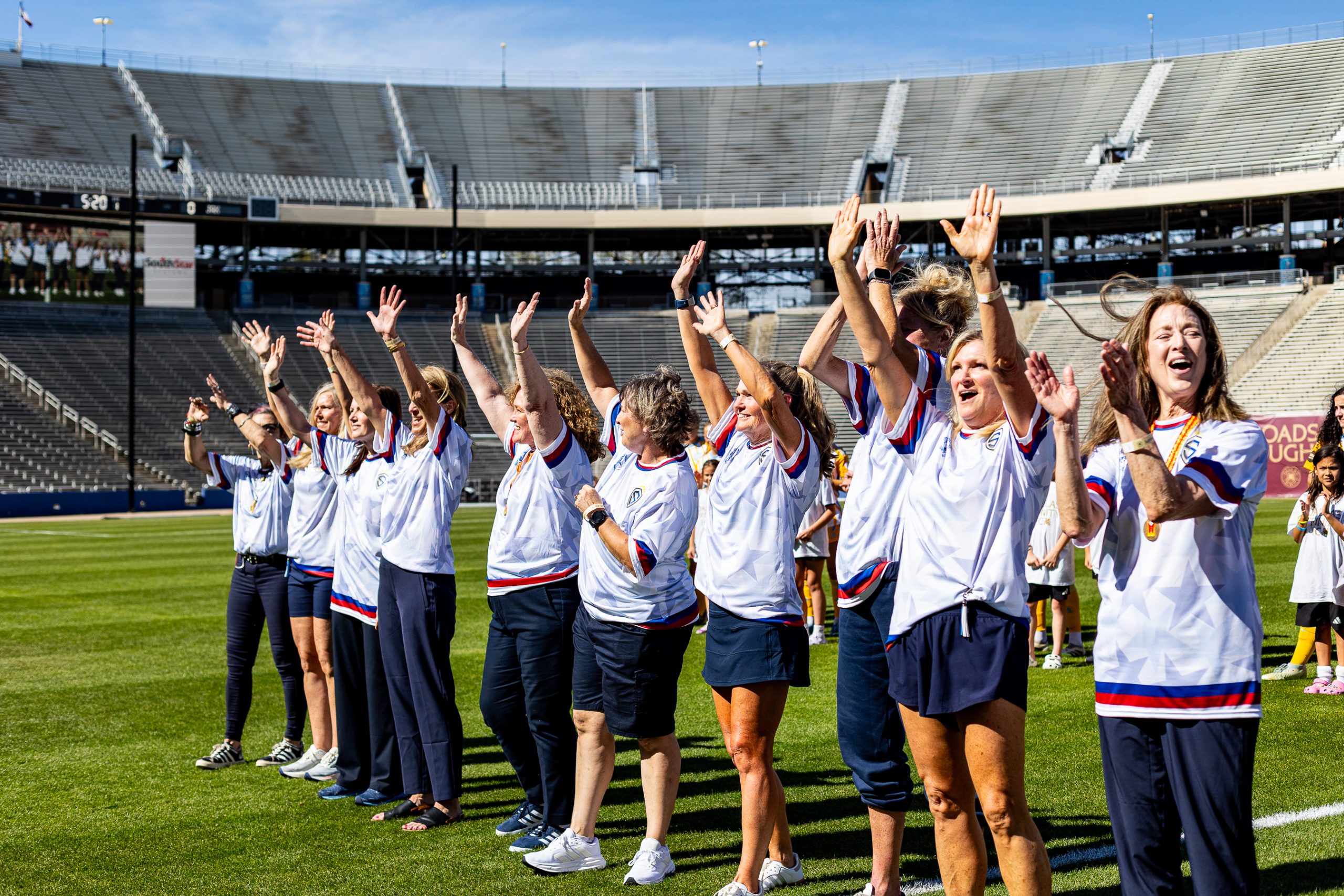
The room Dallas Trinity FC set aside for Sunday’s pregame panel wasn’t large, but the stories of the thirteen women who filled it certainly were. Casey Jones, Amy Ecklund Misel, Dr. Megan Rust, Michelle Conaway Kinsey, Alicia Tanner Donnellan, Pam Betz Glowry, Dr. Jennifer Lawson Matthews, Melinda Gurdon Reese, Erin Adamson O’Donnell, Sherry Mungai, Barbara Garland Landrum, Tony Catchings, and Tina Edgar Fowler sat on that stage as members of the 1984 Dallas Sting, the first women’s soccer team to represent the United States in a FIFA-sanctioned international tournament, and the first American team of any kind, men’s or women’s, to win a major FIFA title.
Before the match began, they walked onto the Cotton Bowl field to a crowd that included current Sting youth players who had made the trip to Fair Park, and Trinity players who came up through the club, among them Cyera Hintzen, who played for Sting before going on to the University of Texas and a professional career now back home in Dallas. During the match itself, fans were finding them in the stands for autographs and photos, the kind of attention that doesn’t usually reach people who have been quietly extraordinary for four decades.

The backstory requires some context. China’s soccer federation reached out to US Soccer in 1984 about hosting the first-ever FIFA women’s international tournament in Xi’an, and US Soccer had an immediate problem: there was no women’s national team.
The inquiry worked its way down to US Youth Soccer, which landed on a U-19 club out of Richardson that had compiled a nine-year record of 400 wins and nine losses. They told the Sting they’d be representing the United States of America, and several of the players who heard that news were fifteen and sixteen years old, some still without driver’s licenses.
Getting to Xi’an was its own story. They flew commercial from Dallas to Los Angeles to Hawaii to Hong Kong, then boarded a Soviet-made aircraft in Guangzhou that more than one woman, sitting on that stage forty-two years later, still couldn’t describe without laughter and visible disbelief. The runway felt endless beneath them, the plane shuddered through rain, and the box lunch nobody touched became a puzzle game to pass the time. Hotel water too orange to drink, public restrooms that were open pits, open-air markets with flies thick over hanging meat. The food was so scarce and foreign that the team was losing weight mid-tournament, and at some point, the staff resorted to seating players and parents in alternating chairs at meals just to make sure the kids ate.
The bracket waiting for them featured full professional national sides, and Group A alone illustrated the level. Italy, anchored by Rose Reilly, widely considered the best women’s player in the world at the time, opened by beating a Chinese club side 5-1, then dismantled Japan 6-0, with Reilly scoring twice in each.
The Sting, placed in Group B, opened with a 1-0 loss to Australia, drew with a Tianjin club side, and finished second in the group. That earned them a semifinal against the same Italy side that had just run up nearly thirty goals in three matches.
They man-marked Rose Reilly and beat Italy 3-2.
In the final, they met Australia again, the team that had beaten them in the group stage and whose coach had been dismissive enough afterward to put a chip on every shoulder in a blue-and-white uniform. The Sting won 2-0, and then came the moment that nobody in that Sunday room could discuss without a change in voice. A victory lap around the field in Xi’an, the American flag carried by teenagers from Richardson, Texas, in front of sixty thousand people, representing a country that didn’t yet have a women’s national team to speak of.
Not many athletes get that, one player said, the chance to represent the United States and then carry the flag in front of a crowd that size. Sharing it with the women sitting on that stage made it something she still couldn’t fully put into words forty-two years on. The room let that sit for a moment. Somewhere in Xi’an that night, the Sting also collected on the ice cream party their parents had promised, which felt like the right way to end it.
The Chinese crowd, sixty thousand strong at every match, had adopted them along the way. After the semifinal, parents and police locked arms outside the locker room to form a tunnel to the bus while fans reached through the windows and chased it toward the airport. Several players said Sunday it’s the kind of thing that has no real comparison, and the closest any of them can get is describing it and watching the room try to picture it.
What they came home to was something else. Tanner Donnellan returned to SMU as an anonymous freshman until a professor stopped class in a full auditorium and asked her to stand, then explained to a room of confused college students the distinction between national champion and world champion. She had to make the correction herself. “We weren’t national champions,” she said Sunday. “We were world champions.”
Women’s college soccer scholarships barely existed yet, so several walked on to their university programs and paid full tuition. US Soccer ran some of them through national team tryouts at Rancho Mirage year after year, handed out windbreakers, but never organized a single friendly match.
Four Sting players were eventually invited onto the 16-player roster for the 1991 FIFA Women’s World Cup, the tournament that launched the dynasty, but only two, Carla Overbeck and Tracey Leone, made the trip.
The games from Xi’an were filmed and aired on Chinese television. The footage exists somewhere in China, the players believe, but none of them have ever seen it, and no one has made a serious effort to retrieve it. Forty-two years later, thirteen world champions sat in a room and could not watch themselves win. US Soccer, which has never formally recognized the Sting as world champions, might consider that a reasonable place to start.
Gurdon Reese kept a journal through all of it. Before the team left for China, she wrote, essentially, that they were going to get destroyed. Reading it back on Sunday, she laughed at herself, because she also wrote about it every single day after that, each game, each meal, each strange and clarifying moment of being a teenager in communist China playing against the best women’s players in the world and winning.
“We didn’t even really understand the depth and significance,” she said. “And to look now, watching these women, it’s so awesome.”
The women she was watching play were just yards away on the other side of the Cotton Bowl’s glass, building the professional women’s game in Dallas that the 1984 Sting made possible and never got to play in. That’s the handoff, not a ceremony, not a panel, but the thing itself, visible through the window on a Sunday afternoon in Fair Park.
Dallas Trinity recognized it Sunday, and the players on that stage deserved to hear the room go quiet and listen. What the Golden Girls are building at the Cotton Bowl runs through Xi’an in October 1984 whether anyone says so or not. These thirteen women made sure, for one afternoon at least, that someone did.
this is so good! the footage would be great and a Doco would be awesome,
well done Dallas trinity and who doesn’t love the Dallas sting now
This is amazing, should go watch dallas trinity sometime