
FC Dallas finished second in the West with the league’s 25th-highest payroll and a club-record 22 goals from Petar Musa. None of the 28 MLS award finalists named Thursday came from Frisco, after a season in which the national press tracked Dallas in its rankings but rarely talked about it anywhere else.
FC Dallas just finished second in the Western Conference. It scored a club-record 62 goals, Petar Musa scored a club-record 22 of them, and the club did it on the 25th-highest payroll in Major League Soccer.
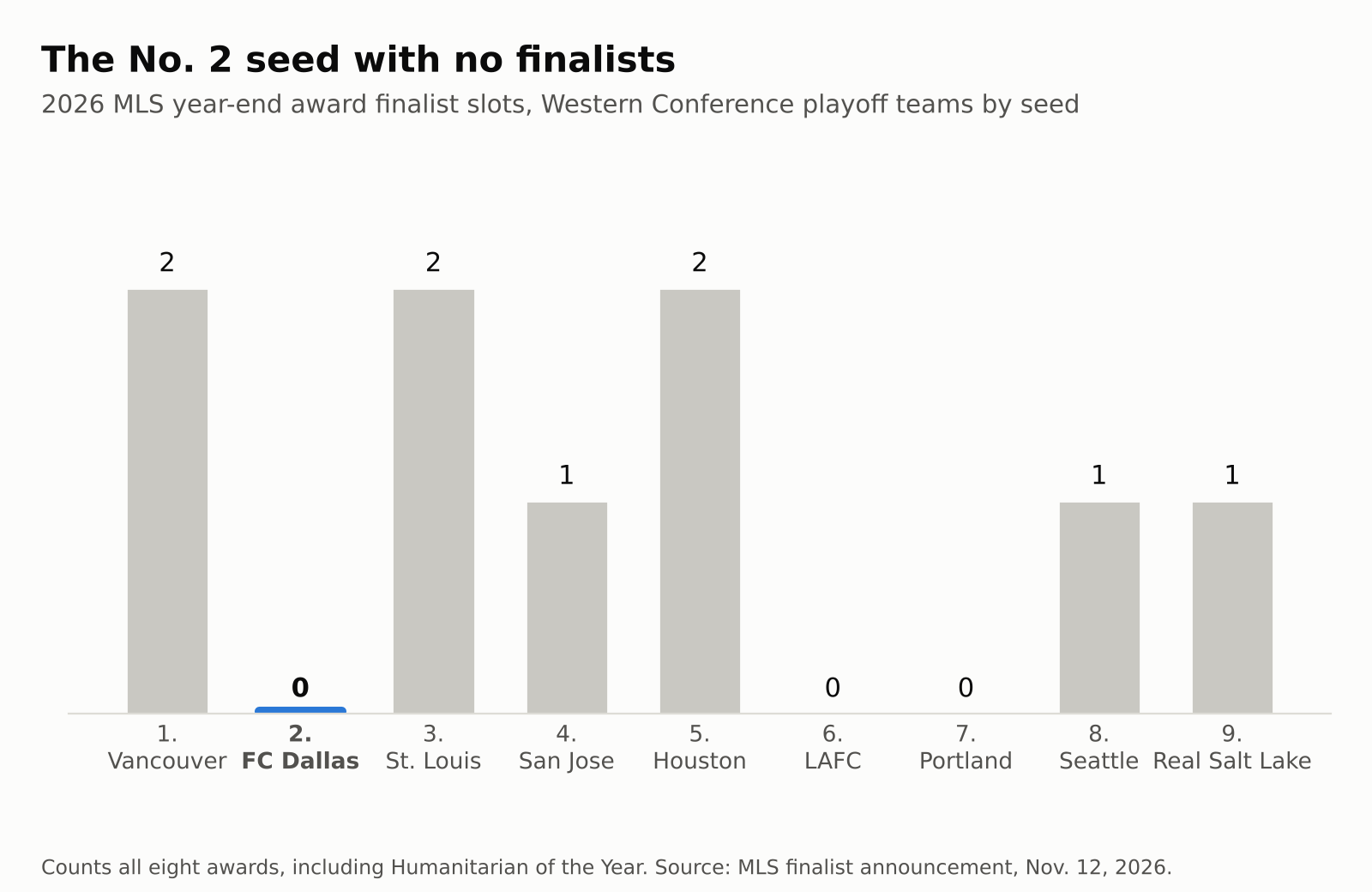
On Thursday, MLS announced 28 finalists across eight year-end awards, and Dallas didn’t have a single one. Every other club in the West’s top five does.
Vancouver Whitecaps, first, has two.
St. Louis CITY, third, has two, including head coach Yoann Damet.
San Jose, fourth, has one.
Houston Dynamo, fifth, has Guilherme in two categories.
MLSsoccer.com had the club sixth in its Power Rankings at the World Cup break and sixth again before Decision Day. Beyond weekly rankings, what Dallas never truly got was a story. The podcasts, columns, and talk shows that shape how people around the league think about a season kept treating the club as a February afterthought that happened to be winning, and the finalist lists look like that coverage.
Let me be clear about this: Lionel Messi should win MVP, and Nashville’s B.J. Callaghan should win Coach of the Year. What Messi continues to do in MLS is nothing short of remarkable. What Callaghan did with this Nashville squad, especially late in the season, makes him, without a doubt, deserving of the award.
Nashville’s defenders have the best claim to Defender of the Year, too. But did all three deserve to be finalists?
Musa, Eric Quill, and Osaze Urhoghide had seasons that belonged among the finalists, and each lost a place to a candidate the national press spent more time on.
“Flown Under the Radar” – A Lack of 2026 FCD Awareness
In early November, ESPN’s awards piece opened its Coach of the Year section by saying Quill’s excellent season “has flown under the radar.” Its three analysts then voted. Jeff Carlisle and Lizzy Becherano picked Callaghan, and Cesar Hernandez picked New England’s Marko Mitrovic.
ESPN’s writers saw that Quill was being overlooked and left him off all three ballots anyway, and that’s how most of the national press handled Dallas this year.

How MLS Award Ballots Get Filled
The year-end awards are decided by three groups: MLS players, club technical staff, and a panel of media members. In 2025, each group carried a third of the result, and media voters such as Jon Marthaler describe the same split this year. Voting opened on Oct. 21 and closed on Nov. 9.
The media third is the obvious part. The rest of the vote came from players in the middle of a playoff push and technical staff scouting their own offseasons, and none of them watched 510 regular-season matches.
It is hard to believe their ballots weren’t shaped by the same podcasts and columns as everyone else’s. A player who rarely comes up nationally reaches the ballot without much of a case attached to his name.
That matters most at the edges. Musa needed a top-five finish to become an MVP finalist, and Quill needed a top-three finish for Coach of the Year. Those are the places where a little more attention moves a candidate onto the list.
FC Dallas – Ranked, Not Discussed
Low expectations in February were fair, especially from anyone outside of Dallas. Hudson River Blue collected 23 published preseason predictions of the West. Matt Doyle was the most generous, with Dallas sixth. Ten of the 23 had Dallas out of the playoffs, including Apple TV’s Bradley Wright-Phillips and Sacha Kljestan, who both had Dallas 11th. MLSsoccer.com’s preseason Power Rankings put Dallas 19th with a one-line verdict: “Safe to say they needed a change.”
The rankings adjusted quickly. By the World Cup break, Dallas was fourth in the West, and MLSsoccer.com’s panel had it sixth in the league. It still had Dallas sixth before Decision Day.
But the conversation never adjusted with them. In October, with Dallas second in the West, Wright-Phillips still called it “one of the surprise teams in the Western Conference.” By then, Dallas had spent five months in the West’s top five.
Doyle’s own ballot column, published Nov. 9 on Tactics Free Zone, grouped Dallas with the season’s disappointing contenders and said, “Chicago and Dallas never actually went for it.” He was talking about spending. Measured by results, the club with the 25th-highest payroll finished second in the West.
Was FCD Smash-and-Grab or Contender?
A lot of that effort came on the road. While Toyota Stadium was being renovated, Dallas played nine straight league matches away from Frisco. They returned home on Sept. 5 with six road wins, then won at Minnesota four days later for a seventh – the club’s most in a season since MLS dropped the shootout – and climbed to second in the West by late October.
Soccerwise is where the gap was easiest to hear. The podcast, one of the most popular in American soccer, has Doyle and Tom Bogert on its regular MLS panel, and anyone who listened through the fall heard plenty about Nashville, St. Louis, Vancouver, and the playoff bubble, yet very little about the team in second place in the West. The show’s episode listings back that up.
National TV did little to change the perception either. FOX Sports gave Dallas just one of its 34 regular-season broadcasts, and Apple TV didn’t feature Dallas in a Sunday Night Soccer window until Aug. 16.
Actual 2026 Voting Results
Plenty of media voters have made their ballots public, in columns, newsletters, and posts on X and BlueSky. The Athletic’s Bogert published his, as did Joseph Lowery for Backheeled, Steve Davis on X, and Ben Wright and Valair Shabilla of SixOneFive Soccer.
Every one of them picked Callaghan for Coach of the Year, and none put Quill among the alternatives. Bogert named three other coaches he expected to be finalists: Damet, Vancouver’s Jesper Sørensen, and New England’s Mitrovic. Their Defender of the Year votes went to Nashville’s Maxwell Woledzi, Jeisson Palacios, or Chicago’s Mbekezeli Mbokazi.
Nashville had a historic season, and nobody did anything wrong by voting for its coach. The ballots show something else, though. The voters who watched Dallas closely enough to know Musa’s season gave him credit, and Bogert, Davis, and Wright all put him in their Best XI. When it came to the coach who built that team on the league’s 25th-highest payroll, nobody on a published ballot thought to mention him.
No Nominations – MVP, Coach of the Year, Defender of the Year
Second Only to Messi
Petar Musa scored 22 league goals. Only Messi, with 26, scored more. Hany Mukhtar scored 17, Guilherme 16, Evander 14, and Cavan Sullivan nine. The other five not named Musa are MVP finalists.
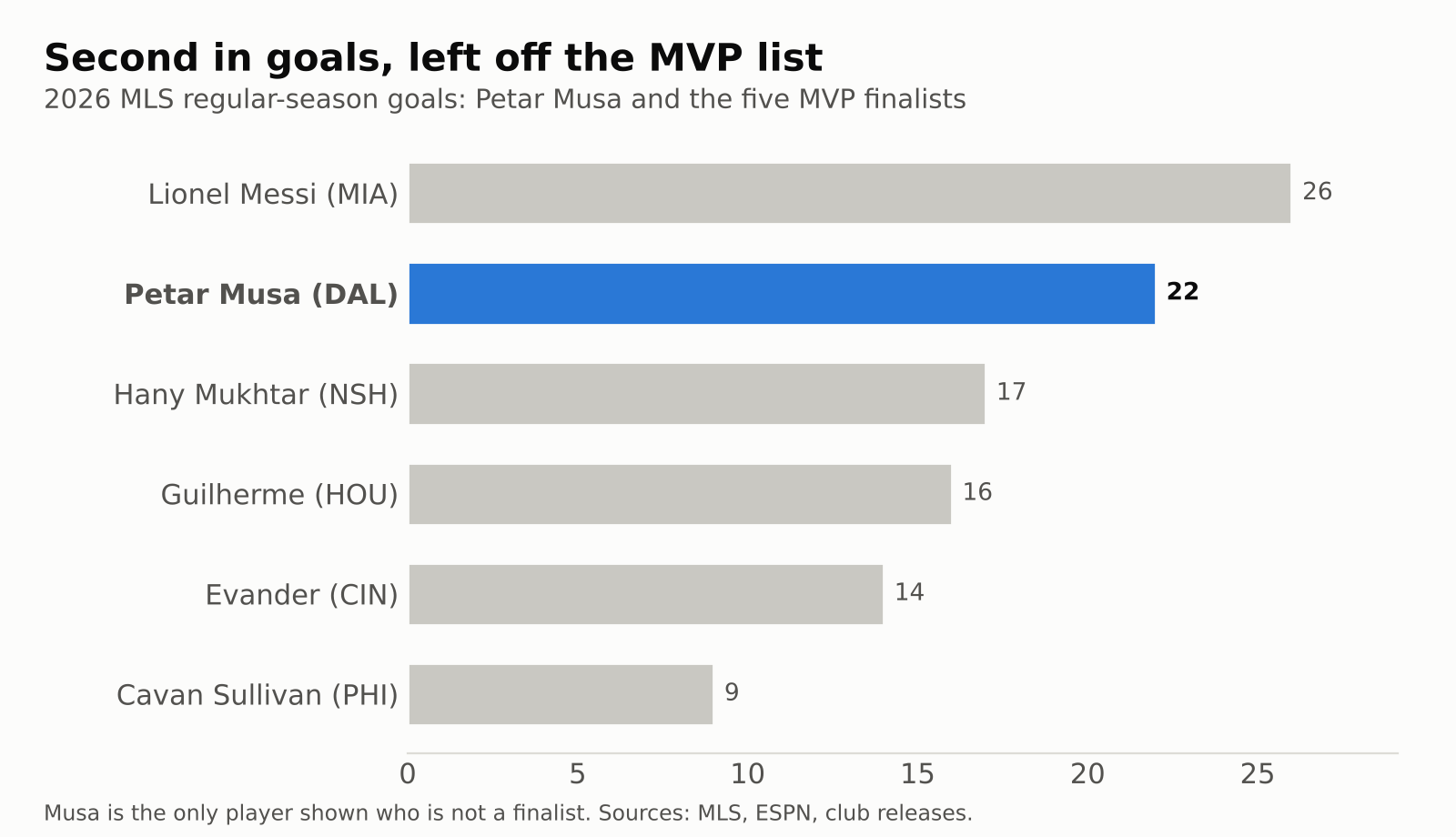
Sullivan is the name that stands out most. He is 17, a U.S. international, and bound for Manchester City, and he is the youngest MVP finalist in league history. He also sat out half the season. He started six league matches before the World Cup break and became a regular only after interim coach Ryan Richter gave him a bigger role in the summer. From there, he was excellent, finishing with 23 goal contributions in 21 starts and September’s Player of the Month award, and he should win Young Player of the Year.
MVP is a full-season award, though. Musa played in 30 of Dallas’s 34 league matches and finished four goal contributions ahead of Sullivan for a team that finished higher in the standings. Sullivan had the bigger national story.
Musa’s goals propelled Los Toros. In the 15 matches he scored, Dallas went 9-4-2 and took 2.07 points a game, a pace that would have finished second in the league. In the 15 he played without scoring, Dallas won just four.
As the season went on, the analysts who followed him closely came around. Kljestan, who had picked Dallas to miss the playoffs, ranked Musa third in his final MVP Power Rankings, ahead of Evander, Guilherme, and Sullivan. Bogert wrote that if his ballot had gone three deep, Musa would have been one of his runners-up, calling him “a singular force” in Dallas’s run to second.
Musa’s case got made, but only by a handful of writers and only at the very end of the season, after months in which he barely came up on the national shows. Musa should have had Sullivan’s spot on the MVP list. Sullivan’s season is already well served by the Young Player award.
A Texan Nobody Talked About
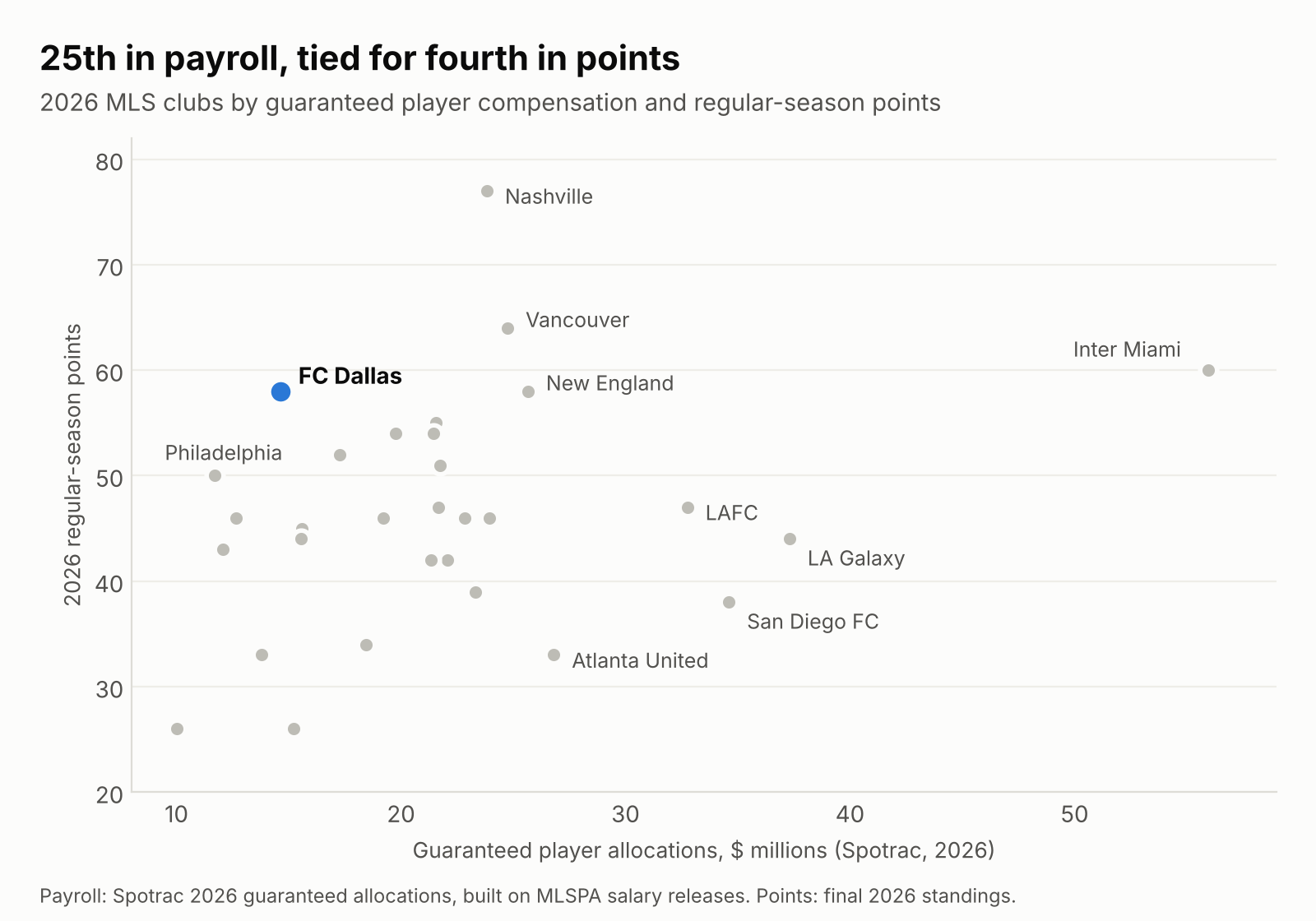
Coach Eric Quill is from Missouri City, outside Houston. In his second season, Dallas improved from 44 points to 58 on a payroll Spotrac puts at $14.63 million, 25th of 30 clubs and $6.8 million under the league average. After Luciano Acosta, Leo Chu, Maarten Paes, Sebastian Lletget, and Paxton Pomykal left within a year, Musa was the only Dallas player earning $1 million or more, and the club fell from 12th in spending to 25th.
Three West clubs spent more than twice as much and finished well below Dallas. The LA Galaxy spent $37.31 million and finished with 44 points, San Diego FC spent $34.61 million and finished with 38, and LAFC spent $32.76 million and finished with 47. No other club among the league’s 10 lowest payrolls reached 53 points.
Quill got 10 league goals out of Logan Farrington, on $417,000 in guaranteed pay, and 13 assists out of Joaquín Valiente, on $442,022, in Valiente’s first MLS season.
Damet’s case is real. St. Louis went from 32 points in 2025 to 54, a bigger jump than Dallas’s 14, on a $19.76 million payroll.
The finalist Quill should have replaced is Sørensen. Vancouver had a record season, but the Whitecaps were the 2025 MLS Cup runner-up, started 2026 third in MLSsoccer.com’s preseason rankings, and spent $24.75 million. Sørensen’s team did roughly what it was expected to do. Quill’s finished far above its projections on a much smaller budget.
Every published Coach of the Year pick, from ESPN’s three analysts and Wright-Phillips to the ballots of Bogert, Lowery, Davis, Wright, and Shabilla, went to someone other than Quill, and Bogert’s list of likely finalists didn’t include him.
Two Hundred and One Duels
Osaze Urhoghide wasn’t going to win Defender of the Year over a Nashville back line that allowed 25 goals, the fewest in league history. He should still have been on the shortlist.
Among the 119 MLS defenders who played at least 1,500 minutes, Urhoghide won 201 duels, second only to Philadelphia’s Nathan Harriel. He won 62 percent of them and 67 percent of his aerials. Palacios and Woledzi won a higher share, 65 and 69 percent, but they were asked to do far less. Urhoghide won about seven duels per 90 minutes. Palacios won about five and Woledzi about four.
Dallas conceded about 1.3 goals per 90 with Urhoghide on the field and more than two without him. In September, he played every minute of back-to-back shutouts against Austin and LAFC and scored the only goal against LAFC from a corner.
The third finalist is Nashville’s Andy Nájar, a right back who won 49 percent of his duels. All three finalists play for Nashville, only the second time one club has filled every finalist spot for an MLS award. Urhoghide belonged ahead of Nájar.

Media Objections
One objection is that Dallas faded late. They lost 2-0 at home to Columbus and drew 1-1 at Sporting Kansas City in its last week before Decision Day, then beat Colorado and finished second anyway. Two poor results at the end of a 34-match season shouldn’t outweigh the 32 that came before them.
Another is that Dallas is a quiet club in a crowded sports market. Dallas-Fort Worth is the fourth-largest television market in the country, and the club has 30 years of MLS history in a metro area that hosted World Cup matches this summer. A second-place team with a record-setting striker and a coach who grew up in Texas should have been an easy story to tell.
The last objection is that coverage follows winning. Yet, only three clubs in MLS finished with more points than Dallas. National coverage in 2026 stayed with the clubs and players it had focused on in February, and Dallas wasn’t one of them.
What Should Change
Some of this is easy to fix. MLS should publish every media ballot, the way the NBA does, so voters can be held to what they picked.
National outlets and podcasts should let the standings, and not February predictions, decide where their attention goes by midseason. MLS and its broadcast partners have flexed Dallas matches onto FS1 before, and a team that spends five months in the top five should get that treatment from time to time.
None of that would have guaranteed Dallas a finalist. It would have given the people filling out ballots a fairer look at the team. Dallas’s next national broadcast is Game 2 of its first-round playoff series, at Portland on Nov. 28, on FS1. It will be only the club’s second match on FOX’s national schedule this year.
