

Javier “Chicharito” Hernández stepped up to the penalty spot last November with his boyhood club’s season resting on it, and he sailed the ball over the crossbar. It was the 80th minute of a Liga MX quarterfinal with the match level, and when he missed, Cruz Azul went the other way and scored in stoppage time to knock Chivas out.
He walked off the Estadio Olímpico Universitario field that night and did not play another competitive match. Chivas let him go eleven days later, and he would come to call that miss the most painful moment of his life. In the months after it, he was not sure he wanted to keep playing at all.
He answered that question on Tuesday, in a press room at Cotton Bowl Stadium packed with more cameras than any Dallas soccer event outside the World Cup has drawn in recent years, where he was introduced as the first player Atlético Dallas has ever signed.
Head coach Peter Luccin and sporting director Brian Corcoran flanked him at the table in front of an Atlético Dallas backdrop, and for most of an hour Hernández talked less like a star chasing one more season, and more like a man explaining how he had talked himself back into the game.
He had come close to leaving it for good, and he was unusually plain about why. Somewhere in the back half of a disappointing second spell at Chivas, he had started to resent the sport, and he stepped away to protect his own health before the resentment hardened.
When a reporter asked how he was doing as a person rather than as a player, he stopped to thank the man, because it was not a question he often gets, and he described it as a kind of fortune that he had put his mental health ahead of playing and still had this land in his lap. “I almost start resenting this sport, rather than be grateful,” he said, “and that’s why I came back. For my career and my feelings, I deserve to end my career being happy.”

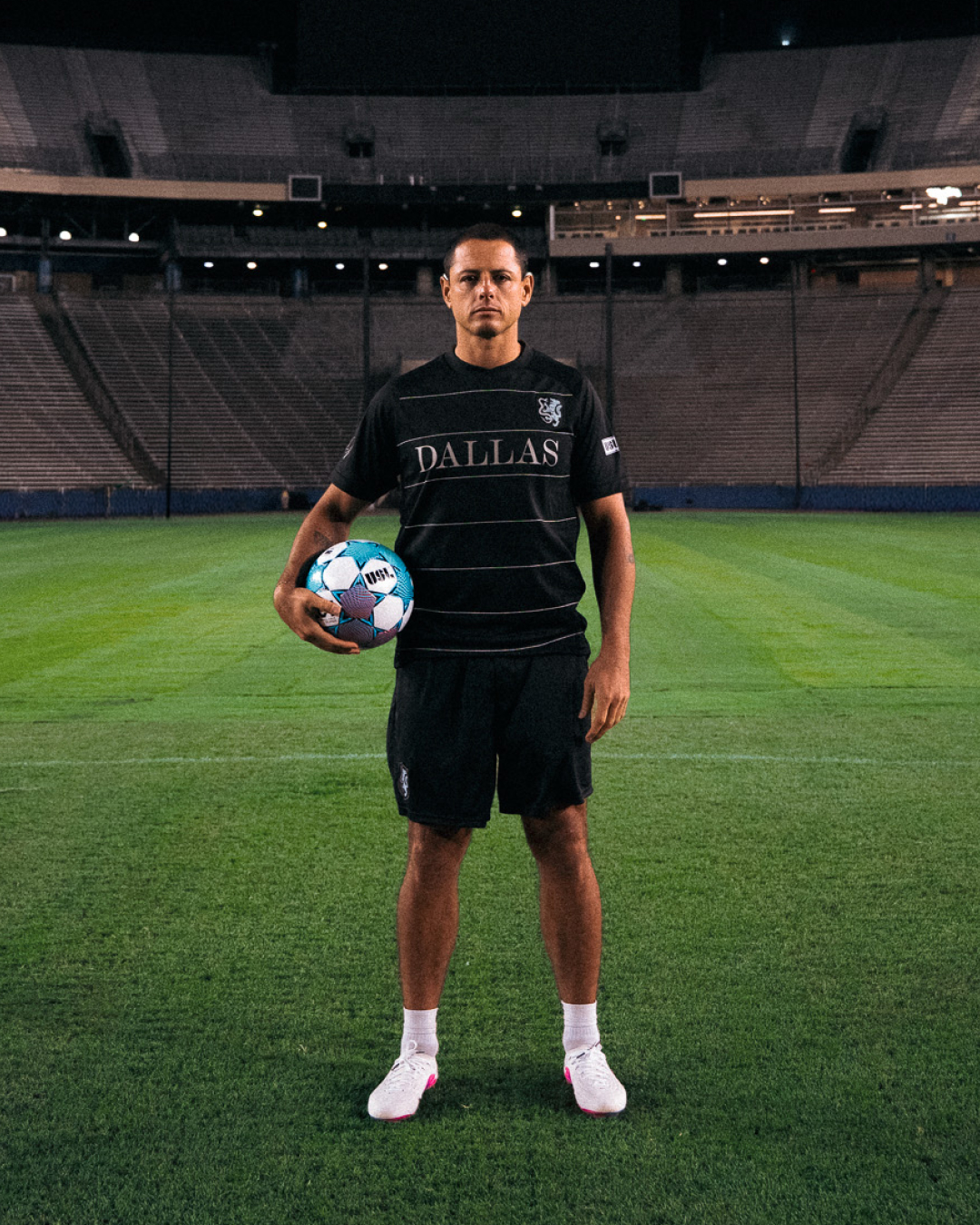
He had not really left the game this past year so much as sat beside it. Hernández spent the 2026 World Cup as a studio analyst for Fox Sports, work that kept him close to the sport and, for a tournament that brought nine matches to town, put him in Dallas more than anywhere else. He called the broadcasting a new side of himself, and at some point the city got under his skin; after one June appearance he posted that Dallas was starting to feel like home (a line the club was happy to play back to the room). The year he stopped playing turned out to be the year Dallas got hold of him.
He signed a two-year deal with a club option for a third, and by the time it starts he will have been out of competitive football for well over a year. Atlético does not play its first USL Championship match until 2027; Hernández reports in January and turns 39 that June, which leaves an odd, open stretch between a man’s last match and his next.
How a striker that age holds his sharpness through a year and a half without a competitive game is a real question, and not one the morning lingered on. If anyone in the room took this for a farewell tour, though, Hernández spent a while arguing the reverse, pointing out that a club had wagered two years and the face of its franchise on a 38-year-old rediscovering his fitness and his form, and that the bet was theirs as much as his.
The most interesting thing he said all morning had nothing to do with his own return. Asked what American soccer still needs, Hernández laid out a theory he has clearly been turning over for a while, that the country built its game in the “wrong order” after 1994, starting at the top of the pyramid instead of the bottom. MLS went out and bought teams and stars and exposure, he said, and that part has worked; he pointed to Lionel Messi and Casemiro, and to the American schools and academies now pushing talent up from underneath.
What the country never built, he claims, is the middle. The tier where the players who have aged out of prospect and never quite reached star status spend their careers, and those, in his telling, are the ones his championship teams in MLS were actually made of. He sees tending that middle as the USL’s real job, and he sees the warning in the country he came from, where Liga MX abolished promotion and relegation and closed the road that once let a 24-year-old tear up a second division and earn his way into the first. He would not point the same critique at MLS, and said so, calling it a conversation for another day.
There was an irony in it he chose not to name, that the case for the unglamorous middle of the pyramid was being made by a decidedly glamorous name, brought in precisely because he can sell a second-division club that has not yet played a game.
The league he has joined says it wants to move his way; it announced a first division, USL Premier, back in January, with promotion and relegation meant to arrive alongside it in 2028. But the whole thing is still an idea more than a plan, with none of the mechanics settled anywhere, and Atlético holds no guaranteed place in any of it. He has signed on with a second-division club that means to become something larger and cannot yet tell him how.
Dallas has run a version of this play before, though Hernández declined the invitation to say so. When a reporter pointed out that he was the second Mexican great to launch a project in this city, thirty years after Hugo Sánchez, he let the comparison pass and went back to gratitude, but the history is worth more than he gave it.


Sánchez arrived as the Dallas Burn’s very first player for the inaugural 1996 MLS season, 37 years old with Real Madrid and Atlético Madrid behind him, installed at this same Cotton Bowl and sold to this same Hispanic market, and he made the pitch work for a year before he went home to retire. He played 23 matches. The Burn drew a little over 16,000 a night that first season and barely 9,600 the next, which is to say that the last time a Dallas club signed an aging Mexican legend to open at this stadium, the novelty held for about a year. That is the risk sitting underneath all the good feeling in the room.
Corcoran, for his part, made no pretense that the arithmetic was about anything but bodies in the building. The signing had drawn exactly the crowd of cameras the club had gone looking for, he said, and he was blunt about what it was in service of: “We expect to bring people in the stadium. And quite frankly, this project doesn’t work unless we can do that.” His safeguard against the whole thing curdling into a stunt was the local football crowd itself, which he trusted to sniff out anything false, and the squad he described wanting to build had less to do with a marquee name than with its anonymous middle, the players ranked somewhere between fifth and fifteenth who scrap for a weekend place and set a team’s character. It was Luccin’s reputation in the game, he added, that made a signing like this one possible at all.
Hernández keeps a ledger that reads nothing like the one belonging to the man selling the tickets. Pressed on how much sway he would hold over the players who follow him to Dallas, he pushed the premise off the table: “This is not Chicharito’s team. I’m one piece. It does nothing for me or for Peter if I score 30 goals in the season and we don’t qualify.”

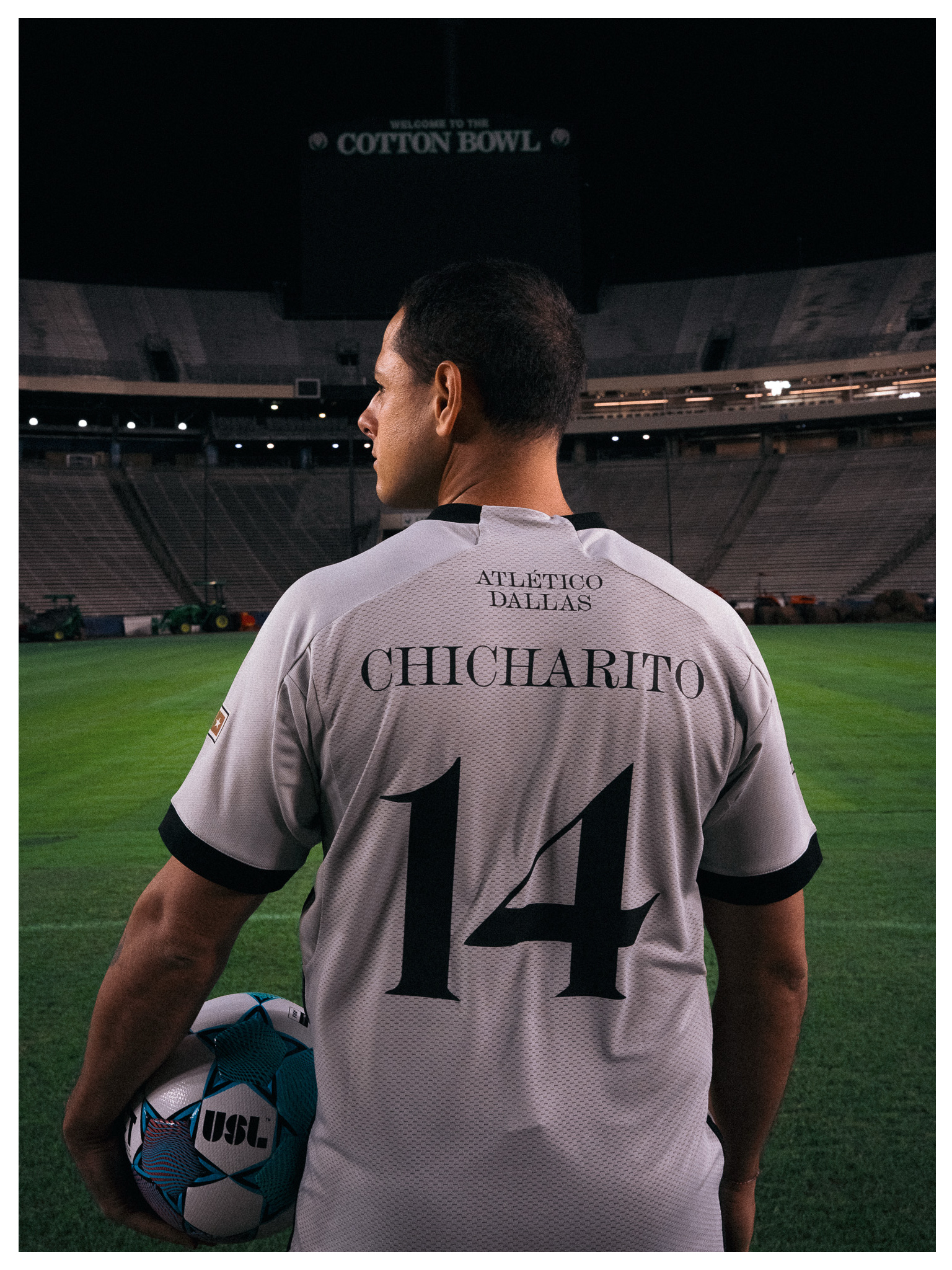
He was no warmer on the question of his own legacy, saying he had never done a thing in his career to be remembered by, and that he had met enough prolific goalscorers he would not care to share a meal with to know that the goals were not the measure of a person. The closest he came to a creed was a line from his mother; words convince people, but example drags them along behind you.
Luccin used his time at the microphone trying to take the weight off the whole thing, insisting he and Hernández had only ever talked about football and that it was matching ambition that drew them together. “No pressure on Javier,” he said. “Javier is our first chapter, but Atlético Dallas is bigger.”
He means to give real minutes to teenagers and wants local kids in the shirt, and he expects Hernández to teach them more through the way he trains than through anything he says to them.
Hernández, when his turn came back around, made that same argument from a player’s chair. He had met the Dallas Trinity FC squad the day before, he said, and one of them had asked what he misses most about the game, and the answer was not the matches. A season might hold fifty of those, he figured, with two or three times as many training sessions behind them, which leaves the part anyone actually watches as a sliver of the job. “The most important part of a team is what you don’t see,” he said.
The part everyone will see is the harder one, and there is nothing glamorous about it. When 3rd Degree asked how a body at 38, turning 39, would stand up to a division of turf fields, borrowed baseball parks, and long regional legs by bus and by air, and to more than a year away from the game on top of all that, Hernández did not reach for reassurances about his fitness. He said he was not worried about any of it, that the club would travel however it was told to travel, and that the talented people around him would handle his recovery, because the whole of the job, as he sees it, comes down to being available.
It was the turf that he took personally, and it drew the truest thing he said all afternoon. “People forget sometimes. I don’t forget,” he said. “I grew up training in dust, literally, without the grass. I played there for 10 years.”
Atlético Dallas sells itself on three words: Glory from Dust. Its first player did not need them explained to him. The dust is real, and it is already behind him; the glory is the part he came here to chase.
“the last time a Dallas club signed an aging Mexican”?
Like FC Dallas signing Dulio Davino?
He was 32, played like he was 62.
My prediction is Chicarito never plays a minute for Dallas.